How do you race someone you have never met?
Have you ever tried to break a high score in a video game for no reason other than the fact that some stranger put their name at the top of the list? You do not know who they are, or where they live, or even whether they are still alive (some high scores date back to the Atari days!), yet you find yourself trying again and again, just to prove you can beat them.
Interestingly, we do not always need an opponent in front of us to feel a burning desire to win. Sometimes it is enough to know that someone else managed to do the thing better than we did.
That is what got me thinking about a problem we ran into while building LettersWay.
In the previous post, "What if you were alone?", we tried turning the group game into a solo experience, and the result was Knowledge Paths. But something important was still missing. We had carried the questions over into a solo experience — and left the hexagonal board, the paths and the competition behind.
So what if we could make everyone race across the very same board, without ever meeting?
Racing the unknown
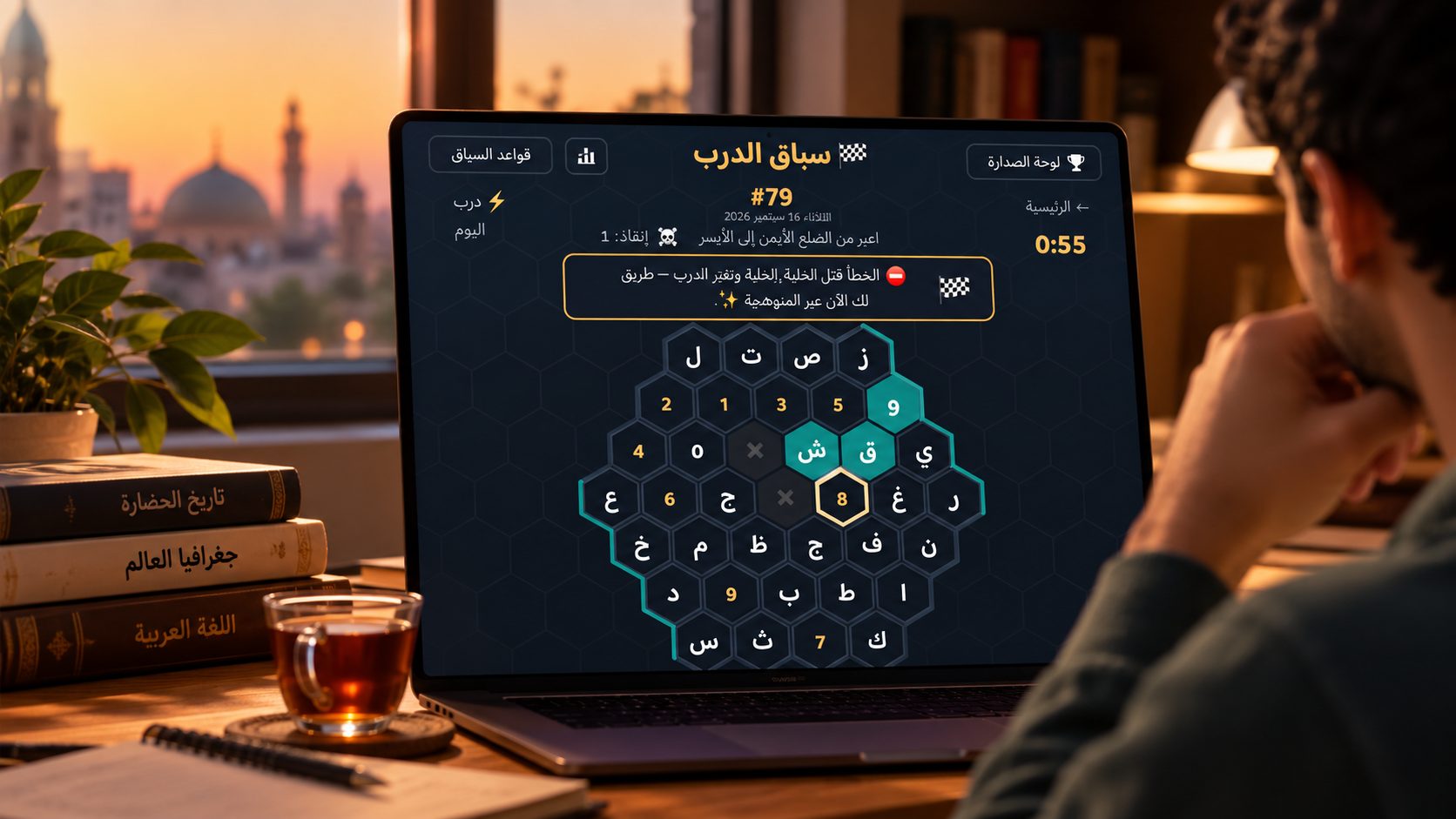
The idea was simple: every day, all players get the same board, with the same letters and the same questions, and each one tries to cross it from the right edge to the left edge as fast as possible.
But we hit a small problem. If there is no rival cutting off your path, what is stopping you from strolling across with ease?
We decided to make the mistake itself your rival.
When you pick a cell and answer correctly, it becomes part of your path. But if you get it wrong twice, the cell dies for good, and you have to look for another way across — probably a longer one. And if every road closes in front of you, you have exactly one rescue: reopen a dead cell by answering a brand-new question.
And so every answer gained a price and every mistake gained consequences. Knowledge alone was no longer enough to win; you also have to choose the right route and decide quickly, before the clock gets ahead of you.
Is the best player the fastest one?
When we started testing the idea, we realised that reaching the end does not necessarily mean you are the best. One person may pick a shorter route while another is forced to detour around the cells they lost; both may know the very same answers, but one of them retrieves them faster.
That is why we made every player face the exact same challenge, so the comparison rests on the same conditions — then we added a daily leaderboard where every player can see their rank and share their time with friends.
And to keep the game from becoming an exercise in frustration, we ran thousands of simulated rounds before building it. We found that a player who knows seven answers out of ten completes the crossing in more than nine attempts out of ten, in roughly two and a half minutes.
And so we ended up with a challenge short enough to play while waiting for your coffee — yet one that may make you rethink what winning means.
The end of the path
When we started building LettersWay, I believed competition needed at least two people. It turns out that is not true. Sometimes a mere number on a screen is enough to make us try harder than we thought we could.
And the funniest part is that the person you are trying to beat may well be yourself — when you come back the next day trying to prove you have become faster, or more knowledgeable, or less prone to mistakes.
In the end, what matters is not only that you reached the opposite edge, but how you got there, and how many times you had to change your route.
As for me, I still believe the shortest path between two points is a straight line — unless you miss the geography question, in which case you may have to go around half the board!
Try Path Race, then tell me: how many cells did you lose before you reached the end?