How to ruin a game before it starts
Imagine you have invited a group of friends over for a fun evening. After dinner you suggest a group game, everyone agrees enthusiastically and gets ready to compete — except that first you ask them to take out their phones, then scan a QR code, then type in their names, then pick their teams, then wait until everyone has finished joining.
So far it all sounds perfectly normal, doesn't it?
But wait. One of them cannot scan the code. Another has forgotten his phone's password (I have no idea what that has to do with anything, but he insists it is the problem). A third is asking whether he needs to download an app. Grandma has decided she would rather not play at all, and the little one has seized his father's phone and is already playing something else entirely!
Ten minutes of trying to gather everyone later, you discover that half of them have lost interest, the other half are busy with their phones, and you are the only person in the room still excited about the game.
Congratulations — you have successfully ruined the evening before it began!
The problem is that this scenario was not far from what was happening in LettersWay.
When the problem comes before the game
From the beginning, our idea was to gather people around a competitive knowledge game: racing to answer questions, claiming hexagonal cells, and building a path that connects two sides of the board.
But when we started watching how the game was actually used, we discovered something strange: a fair number of visitors were pressing "start a round"… and then disappearing!
Not a single question answered. They never even reached the board.
Were the questions really that hard? Was the game not attractive enough? Had we overcomplicated the rules?
It turned out the problem was not in the game at all, but in the steps that come before it.
We had designed an experience that assumes every player has a phone, that everyone is ready to join the session through it, and that someone is there to manage the whole operation before the competition begins.
Which is a very logical assumption when you are the game's developer, sitting at your computer, with three phones for testing and plenty of time to try every button.
But family gatherings do not work that way.
In a single majlis you may find three different generations: some love video games, some do not know the difference between a browser and an app, and some do not want to take out their phone at all — and that is their right; they came to sit with people, not with their phone!
And so we began to wonder: should people adapt to the game, or should the game adapt to people?
One phone is enough
One of the things I love about classic TV game shows is that they need no lengthy explanation. A question appears on the screen, a group of contestants tries to answer it, and a host runs the competition.
Nobody needs to create an account, download an app, or enter a secret code.
All you have to do is sit down and take part.
So why shouldn't LettersWay work the same way?
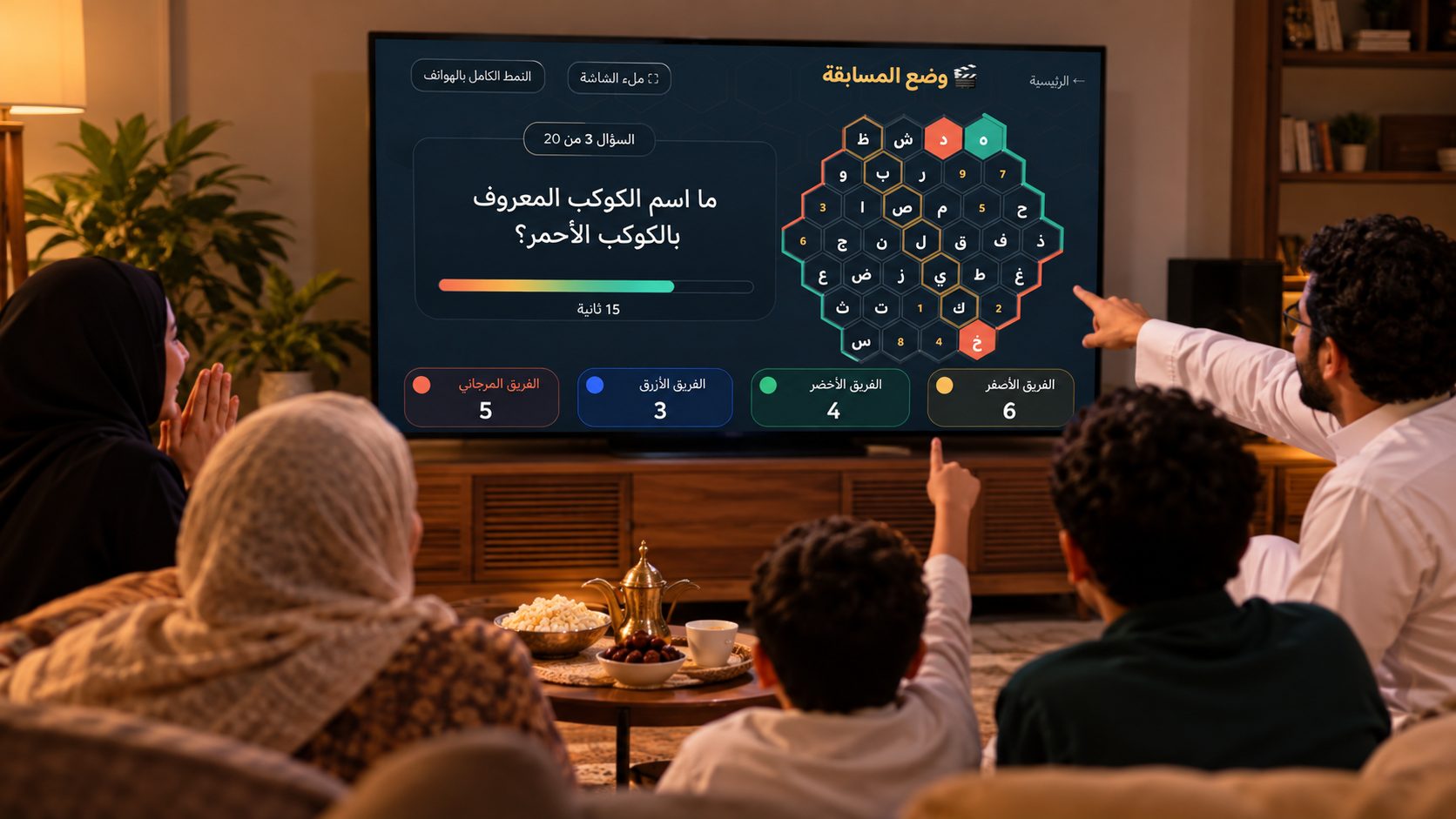
That is where Quiz-Show mode began: a new mode that lets you run the game from one single screen — shown on a TV or a computer — while everyone competes without ever needing their phones.
The question appears on the screen, the time bar starts moving, the players race to answer, and when time runs out the correct answer appears automatically. All the host has to do is point out the team that answered first.
Then the hexagonal board returns, the winning team picks its next cell, and the competition goes on.
And because we know that silence while waiting for an answer can turn a quiz into a school exam, we added some sound effects too (don't worry, you will not hear the teacher demanding you hand in your paper).
But most important of all: we shortened the distance between wanting to play and starting the game to roughly one button.
The problem with four
With the starting problem solved, another one appeared.
The original LettersWay rules are about forming a connected path from one side of the board to the opposite side — a delightful rule when two teams compete. But what if four teams or more join in?
That is where the trouble begins.
Picture four teams competing on one hexagonal board, each trying to reach the opposite side while cutting off everyone else along the way. The board gradually turns into a web of tangled paths, and the chances of winning shrink the further the game goes.
You can reach a point where everyone has claimed a pile of cells, yet nobody can reach the other side.
And so the match drags on with no clear ending, until somebody loses patience and demands a draw (usually the person sitting in last place).
So we decided to try a different rule.
What if winning did not require reaching the opposite side at all?
What if forming a straight line of four adjacent cells was enough?
And that is how the Four-Path mode was born.
Just four cells
In this mode, the first team to form a straight line of four adjacent cells — in any of the three directions the hexagonal board allows — wins on the spot.
Crooked lines do not count, and neither does jumping over cells. What is required is four connected cells in one straight line.
The rule may sound simple, but its effect on the competition is enormous.
Instead of every team struggling toward a distant edge, each one can now build a short line of its own while watching its rivals' lines and cutting them off.
And to make sure this rule did not make games too short or too long, we ran thousands of virtual rounds in computer simulation and compared the results with the original mode.
The results were encouraging: most rounds now end with a clear winner within about twenty minutes, instead of the competition dragging on without a decision.
And if the board fills up before anyone completes a line of four, the team holding the most cells wins — and if two teams are tied, one final question settles it.
The board itself now decides when the game ends.
When is simplicity an innovation?
When we talk about product development, we usually think of adding new features: more options, more buttons, more things the user can do.
We forget that every extra feature can be a new obstacle for someone who does not need it.
To us, players joining from their phones was a wonderful feature: it gives every player direct participation, secret power cards, and a buzzer to race for.
But to a family that wants to spend twenty minutes on a cheerful quiz, the very same feature can turn into a problem.
That does not mean the original mode was wrong — it means it was not the right fit for every occasion.
Just as some people love driving a manual car and others prefer an automatic, both want to reach the same destination (with varying amounts of shouting along the way).
So we did not get rid of the original mode. We kept it for those who want the more interactive experience, and added Quiz-Show mode for those who want to start playing with as few steps as possible.
The bottom line
We set out to build a game we believed would bring people together, then discovered we were asking them to busy themselves with their phones before we brought them together!
A paradox worth pausing over.
The real competitor of a social game is not necessarily another game, but everything that keeps people from taking part in it: a complicated setup, a rule that is hard to grasp, or a long wait before the competition begins.
We learned that improving a play experience does not always mean adding something new. Sometimes it means removing something that was already there.
If the purpose of LettersWay is to gather people around a shared experience, then its success is measured not only by how many questions they answer, but by how many people actually take part.
And now that everyone can play in front of a single screen, one more question remains:
What if there is nobody in front of the screen but you?
This time, we will not ask you to wait for someone to show up.
We will ask you to race them… even if you have never met.