The day I lost my own game
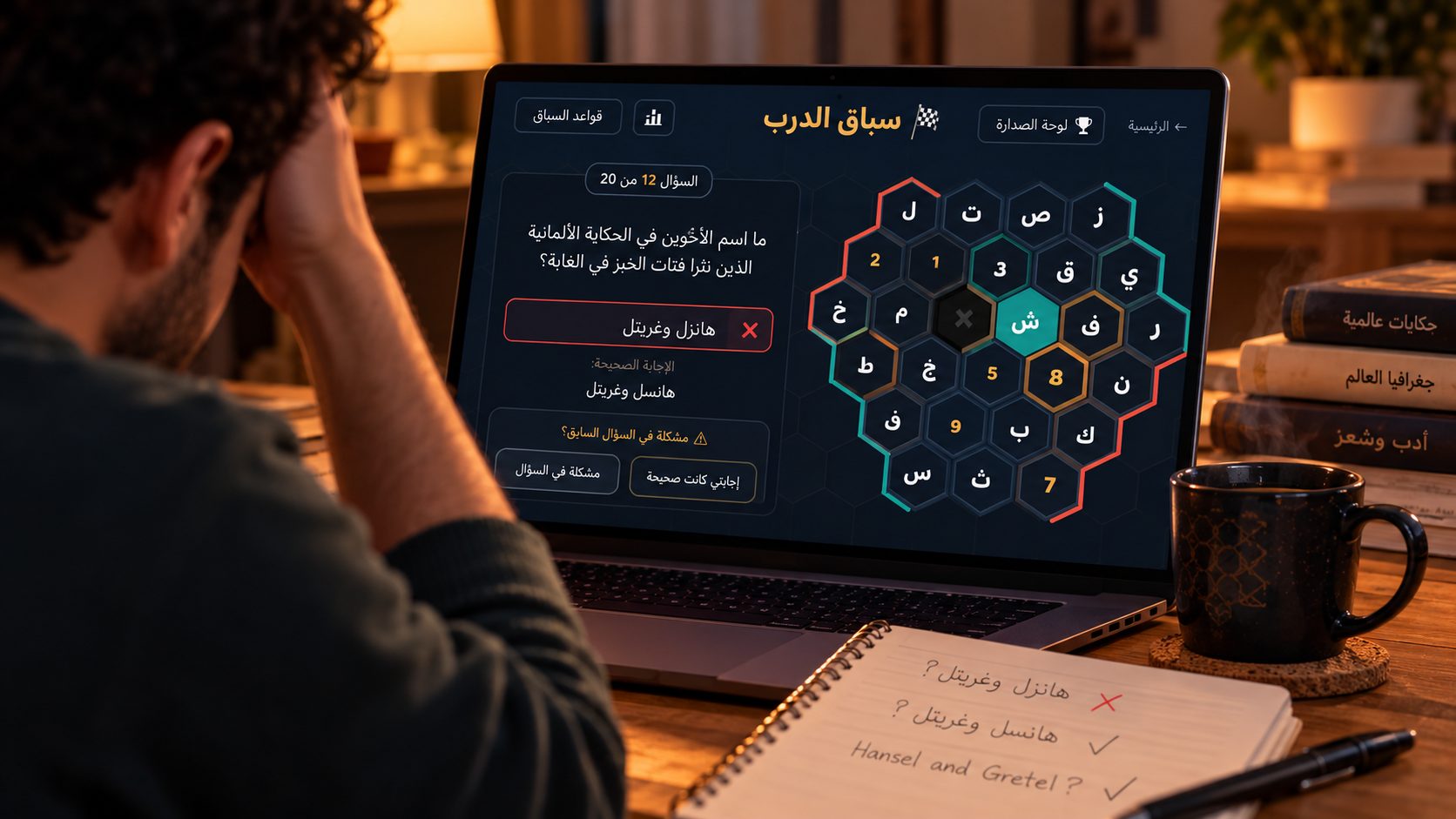
I was playing Path Race with the confidence of someone who knows the game well — not because I am brilliant at trivia, but because I helped build it and wrote many of its questions (a slightly unfair advantage, I admit) — until I reached a question about a famous German tale of two siblings who lost their way in the forest and left a trail of breadcrumbs behind them to find their way home.
What an easy one! "Hansel and Gretel", of course!
I typed the answer and waited for the cell to turn that lovely teal colour. What happened was the exact opposite: the game told me my answer was wrong, the cell died and turned black, and I had to look for another way across!
Wait. What?!
It turned out the approved answer was the Arabic spelling with a seen — هانسل — while I had written it with a zay — هانزل. Both are common Arabic renderings of the German name Hansel, but the game was convinced one of them was right and the other wrong.
The funny part: I helped write the very rules that made me lose!
But who is actually at fault here? The player who wrote a correct name a different way, or the game that recognises only one way of writing it?
When a correct answer becomes wrong
In a game built on letters, the first letter matters enormously — it decides which question you get. The trouble starts when the answer is a foreign name that can be written more than one way.
Take Google. Some of us know it as جوجل, others as غوغل, and some write قوقل — all talking about the same company. But for a letters game, that is three answers starting with three different letters!
And Spotify? Do you write سبوتيفاي or Spotify? And TikTok — تيك توك or تيكتوك?
We began to realise the problem was not knowing the answer, but predicting how the system wanted us to spell it. As if we were not testing the player's knowledge, but their ability to read the question writer's mind!
So we changed the rule. Players can now write foreign names directly in English, or in any common Arabic rendering, and when the answer is a foreign name, a small hint shows its original first letter.
As for Google: it now lives under the letter jeem, with every other spelling accepted — including قوقل (we would hate to anger the people of the qaf).
Who reviews 2,204 questions?
After that incident, a more unsettling thought crept in: if I caught this mistake only because I play my own game every day, how many similar mistakes are hiding in questions I have not caught yet?
We had more than two thousand questions across different worlds, and each one needs a precise answer, clear wording, the right letter, a trustworthy fact, and sometimes several acceptable answers.
The more questions we added, the harder reviewing them became — especially since some mistakes only surface when someone types an answer we never anticipated.
Could I really review every question myself, try every possible answer, and predict every way of spelling every name? (I believe I would need an extra lifetime. Possibly two.)
Then we realised the solution had been in front of us all along.
The players are the ones who discover these mistakes. Why not let them help us fix them?
We added a small link that appears after each question: "A problem with the previous question?" — through it a player can tell us their answer was actually correct, or that something is wrong with the question itself.
And when they choose "my answer was correct", we receive exactly what they typed, letter for letter, so we can review it and add the accepted form where needed.
Reviewing the bank is no longer one person's job; every player now has a hand in making the game better.
In other words: we handed the crowd the red pen, and kept the eraser for ourselves!
When questions change with the seasons
While reviewing and adding questions, we noticed something else: some knowledge becomes more interesting at particular times of the year.
During the Gulf national days, our appetite grows for the history, customs and landmarks of the Gulf states. In Ramadan, questions about the Prophet's biography feel closer to what we are living. And at family gatherings, it is simply fun to test ourselves on the Arabic names of kinship (do you know what a silfah is? Or an adeel?).
That is how "seasons" were born: collections of questions that change with the occasions and times of the year.
We started with "Our Gulf Is One", then "Year of the Family", and we have prepared "Flags and Capitals" for January and "The Prophets and the Seerah" for Ramadan.
And because the game runs on letters, picking questions related to the occasion was not enough — we had to make sure every letter had suitable answers, so no player ends up facing a board they cannot complete.
That is when we discovered some letters were nearly empty in certain topics, so we went hunting for new facts to fill those gaps — until the bank reached 2,204 questions.
The goal was never to add as many questions as possible, but to add the questions we actually needed. One missing letter at a time.
The bottom line
When we started building LettersWay, I thought the biggest challenge was inventing a fun game. I am starting to realise that keeping it good after launch may be harder than inventing it.
A game with two thousand questions is not necessarily better than one with two hundred, if the first punishes a player for a correct answer while the second knows how to handle whatever they type.
The same goes for anything we build: however well we think we made it, the day will come when someone uses it in a way we never expected and finds a problem that never crossed our minds.
That is why I look at mistakes differently now. Every error a player catches is a chance to improve the experience for everyone — provided we are ready to listen.
As for me, I lost a cell in my own game over a single letter, but I gained a lesson worth more than winning that round.
A game should never be smarter than its players. It should become smarter because of them.
Now, if you will excuse me, I am off to today's race to restore my dignity. And this time, if the two German siblings show up, I am typing the answer in English!
(Unless the game decides to ask me about the witch instead.)
Try Path Race today — and if we ever wrong you on an answer, the little link is waiting